




But the terminology can make them sound more complicated than they are.
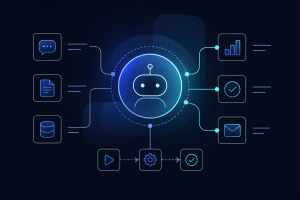
At its simplest, an AI agent is software that can understand a goal, make decisions and take actions to achieve it.
That’s the important difference.
A traditional chatbot primarily responds to what you ask it.
An AI agent can potentially work through a task on your behalf.
Think beyond the conversation
Imagine asking a chatbot: “What leads came in this week?”
It might retrieve the information and give you an answer.
An agent could potentially go further.
It could review the leads, identify which ones meet certain criteria, update a CRM, notify the appropriate team member and prepare a follow-up response.
The key difference is action.
An agent isn’t simply generating an answer. It’s working towards an outcome.
Agents can work with your existing systems
AI agents become particularly interesting when they’re connected to the systems your business already uses.
That could include:
- CRM platforms
- Document management systems
- Customer portals
- Databases
- Project management tools
- Internal knowledge bases
With appropriate permissions and controls, an agent can use information from these systems and take defined actions within them.
This is where AI starts moving beyond a standalone tool and becomes part of a business process.
They don’t need to replace people
The goal isn’t necessarily to create an autonomous workforce.
In many cases, the most valuable application is helping people do their existing jobs more effectively.
An agent might handle repetitive administration while an employee deals with the exceptions.
It might gather information before a meeting.
It might monitor a process and flag something that needs attention.
It might help employees find information that would otherwise take them twenty minutes to locate.
The human remains involved where judgement, accountability or empathy matters.
Agents still need boundaries
It’s important not to think of AI agents as magic software that can simply be given access to everything.
Good agent design requires clear permissions, reliable information, defined workflows and appropriate human oversight.
An agent should know what it’s allowed to do, what information it can access and when it needs to stop and ask for help.
The more important the task, the more important those controls become.
Where should businesses start?
The best opportunities are usually not the most complicated ones.
Look for processes that are:
- Repetitive
- Time-consuming
- Rules-based
- Information-heavy
- Currently dependent on multiple systems
Those are often strong candidates for agent-based automation.
The goal isn’t to use an AI agent because they’re new.
It’s to identify where one can create a measurable improvement.
AI agents have significant potential, but the technology is only one part of the equation.
The most valuable opportunities usually come from understanding your existing processes first, then identifying where an agent can safely remove friction, reduce manual work or improve the customer experience.